
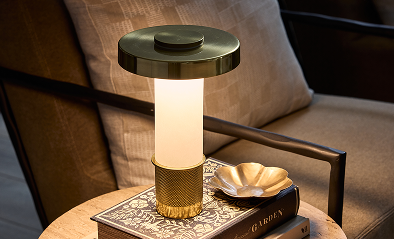


Juba is a Montreal-based design studio bringing a thoughtful, material-led approach to Canadian lighting. Founded by designer Nick Trudel, the studio’s debut piece, the TL-1 table lamp, is part sculpture, part ambient light source, designed to create a soft reflected glow through a distinctive cellulose acetate reflector.
Now available at Lights Canada, TL-1 introduces Juba’s perspective on light, material, and handmade Canadian design. We spoke with Trudel about the inspiration behind Juba, the development of TL-1, and the atmosphere he hopes the lamp brings into the home.
What inspired you to launch Juba?
Nick Trudel: I spent several years in architectural lighting, and I became obsessed with light as a medium. Light is almost a fourth dimension. You’re considering physical form, but also the way that light gets projected into a room. It’s emotional and otherworldly in a way that transcends the three-dimensional object itself.
After working for a larger company, I learned enough to know I needed to do it on my own terms. Following my own curiosity is what makes me feel most alive, and I knew I needed to start something of my own to stay sane and satisfied. Around the same time, my wife got pregnant, and it felt like two huge leaps of faith happening simultaneously. When my daughter was born, I named the studio after her nickname.
How would you describe your design philosophy?
Nick Trudel: I’ve always been interested in the elusive and slippery concept of authenticity, and I think we’ve lived through a time when a lot of design was pulling backward. People feel like the “golden age” is behind us, so everything references previous eras. But I don’t think that’s true. The postwar era had optimism because people believed in a better future, and they weren’t afraid to say so. I want to bring that confidence back to design right now.
My philosophy is about being true to your time. It’s about asking: what does now look like when you’re honest about it? What tools do we have today that we didn’t have before? The TL-1 uses LED technology, and the ring shape only exists because of LED. That’s on purpose. I wanted to make a lamp that says: this is an LED lamp with substance, with confidence, with integrity. Not pretending to be from another era, but celebrating the present moment with enthusiasm and candour.
Can you tell us the story behind the TL-1 table lamp?
Nick Trudel: The DNA for the lamp started almost a decade ago with a school project about cradle-to-cradle manufacturing. The core belief I had then, and still have now, is that truly environmental design has to start with beauty. You have to make things people actually want to use. The environmental piece should be secondary, not the selling point. Otherwise, you’re only preaching to people who already care, while pretty, unsustainable products sit right next to them.
That led me to cellulose acetate. It’s a biomaterial made from wood pulp and cotton fibres with a long manufacturing history. Each sheet is unique, made through a highly manual process. The translucency is unlike anything else. Light comes through it and gives depth to the pattern in a way no other material can. But the thing is, cellulose acetate melts under high heat, which is why it’s never really been used in lighting before. LED changes that equation. LED unlocks this material.
From there, I started thinking about light itself. I was looking at satellite dishes, actually, the inverse of one. In architecture, Frank Lloyd Wright famously used reflected indirect light to create beautiful spaces, but it’s almost never done in table lamps. I wanted to bring that into a domestic form. The reflector bounces light back toward the user, creating this soft, indirect glow that fills a room without being harsh or direct.
The whole thing came together over years of refinement with someone who understood the technical side: the machining, the assembly. We use a dovetail joint on the aluminum stem instead of screws, for example. That’s using the manufacturing method honestly, in a way that’s true to itself.
The TL-1 uses cellulose acetate, aluminum, and cast stone. What drew you to those materials?
Nick Trudel: Each material does something specific, and they contrast beautifully with each other. The cellulose acetate is ethereal and otherworldly. It’s translucent, and it works with light in a way nothing else does.
The aluminum stem is the opposite: rectilinear, geometric, precise, cold. Aluminum is infinitely recyclable, and we process a lot of it here in Quebec, which matters to me. It’s a fairly environmentally friendly material, and it provides a sharp visual and tactile contrast to everything else.
The base is warm and grounded. It’s a mineral composite with a subtle sparkle and fuzziness to it. I wanted harmony through contrast. The base anchors the whole thing, both visually and physically. So you have this ethereal, planar reflector, this cold, precise stem, and this warm, rounded base that grounds it all. There’s an interplay between the three that gives the lamp its character.
What kind of atmosphere did you want the TL-1 to create in a home?
Nick Trudel: It’s meant to be a light sculpture more than a light source. Picture it on a credenza or a side table in your living room, the kind of place where you might have a record player. You turn it on in the evening and just stare at it. It provides a glow, not illumination. You dim it low and let it sit there while you listen to music or entertain guests.
It works beautifully in corners because the translucency of the acetate projects light onto the wall behind it, creating this soft luminescence. But it’s equally beautiful centred in a room, like above a grand piano. Looking at it from behind the acetate is almost like peering into another world. It’s its own thing over there.
The dimmer is essential. You can bring the output down so low that it’s just providing this quiet glow in the corner. It’s more like a candle than a task lamp, something you engage with emotionally, something to kick back and sit with.
How has being based in Montreal, Canada influenced your work?
Nick Trudel: Montreal isn’t a showy city. There’s this beautiful culture of making cool things for the sake of making, not for market or show. People create because they care about the work. That ethos made it possible for me to start Juba. The fact that there’s already this lineage of serious, larger-scale lighting design here gave me permission, in a way, to do the same.
Discover Juba at Lights Canada
With TL-1, Juba introduces a distinctive new voice in handmade Canadian lighting. The lamp brings together cellulose acetate, aluminum, and mineral composite in a sculptural form designed to create atmosphere, warmth, and a soft reflected glow.
Explore Juba and shop the TL-1 table lamp now at Lights Canada.
For a closer look at TL-1’s materials, reflected light, colourways, and styling possibilities, explore our full introduction to Juba at Lights Canada.
